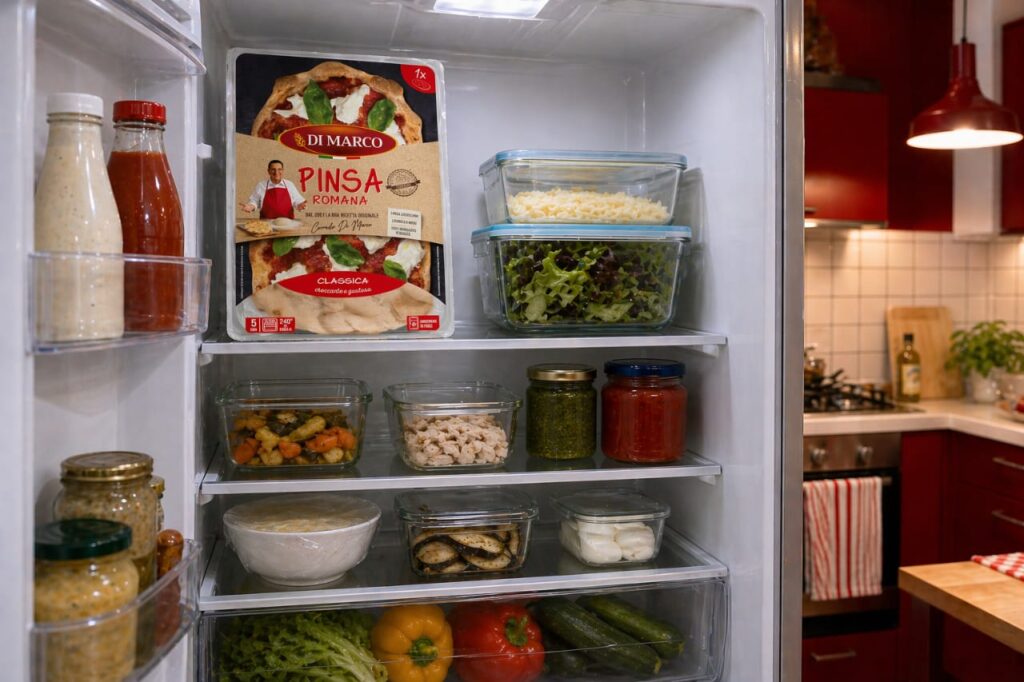
It often happens, especially in the evening, to open the fridge without having a clear idea in mind. It is not necessarily a matter of using up leftovers, but rather of making use of ingredients that are always around the house: a bit of cheese, some vegetables, both cooked and raw, a few cold cuts, and perhaps one or two sauces that have already been opened.
On their own, these ingredients do not suggest a recipe. In fact, the risk is precisely that of throwing them together without any real logic, hoping the result will somehow work. If, however, you have a Di Marco Pinsa in your fridge or pantry, the perspective changes because it becomes much easier to give shape to what you have and turn it into a tasty dish.
In this article, we explain how to do it.
How to create a fridge-cleanout Pinsa without taking risks
When you have complete freedom of choice, you can think about pairings, ingredients and variations. When you open the fridge in the evening, however, you need to make a quick decision with what is available. This is where having a simple framework makes all the difference: a few mental steps that help you avoid random combinations while still achieving a satisfying result.
Start with what needs to be used up
When improvising a fridge-cleanout Pinsa, the starting point is not inspiration but priority. Take a quick look at your ingredients and identify the one most at risk of going bad: an opened cheese, some cooked vegetables, or a package of cold cuts that has already been started.
This automatically becomes the star ingredient of your Pinsa. It is a simple way to avoid waste, but also to immediately narrow down your options and avoid getting lost among too many possibilities.
Choose a direction and build around it
Once you have identified the main ingredient, the next step is to give it a direction. There is no need to think in technical terms: simply understand what type of combination you want to create and move accordingly.
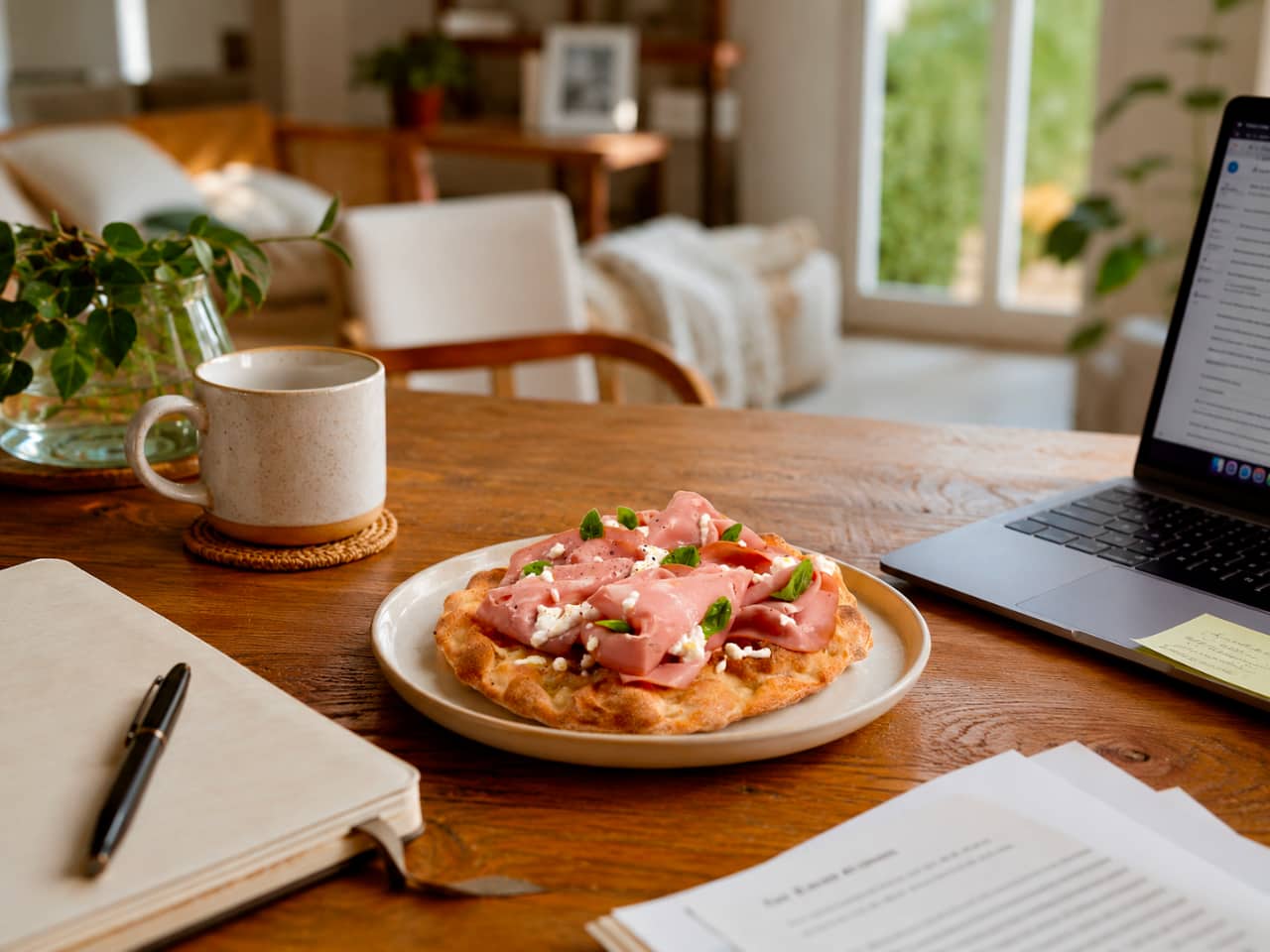
If you start with cold cuts or another savory ingredient, you can balance it with something fresher or more delicate, such as a vegetable or a cheese. If, on the other hand, you have chosen vegetables, especially grilled ones or those with a mild flavor, it may be useful to add an ingredient with more character, such as a cheese or a savory element that provides greater depth.
The principle is simple: avoid piling together ingredients that are too similar and instead look for a bit of contrast. You do not need to create perfect pairings, but rather find a balance that makes the Pinsa pleasant and coherent, even when working with whatever happens to be available.
Limit the ingredients: fewer choices, fewer mistakes
The more ingredients you use, the greater the risk of making mistakes. For this reason, when following a fridge-cleanout approach, one very simple rule applies: use a few elements, but choose them carefully.
Three ingredients are more than enough to create a balanced Pinsa. Beyond that point, it becomes difficult to maintain control over flavors and textures, and the result tends to become confused.
Watch out for moisture: the detail that ruins everything
Some common fridge ingredients, such as cooked vegetables, mozzarella or sauces, release water during cooking. If not managed properly, they can compromise the texture of the base, making it less crispy and heavier.
To avoid this, a few simple precautions are enough: drain ingredients well, avoid excessive quantities and, whenever possible, add the most delicate elements after baking. These are simple measures, but they make a big difference to the final result.
Use cooking to improve what you have
When ingredients are not at their best, cooking becomes an ally. Slightly soft vegetables can become more appealing when properly heated, cheeses can melt and bind everything together, and some flavors become more intense. Think about how baking can enhance what you already have available.
The finishing touch makes all the difference
When working with only a few ingredients, finishing becomes even more important. A drizzle of extra virgin olive oil, a twist of black pepper, a few fresh leaves or an acidic note such as a few drops of lemon juice can completely transform the result. And chances are you already have these ingredients at home.
The most common mistakes when improvising a Pinsa
Having a mental framework helps, especially when you need to make quick decisions with whatever is available. Before that, however, it is essential to avoid some typical mistakes that can compromise the entire result, even when starting with good ingredients. These are situations that are easy to fall into precisely because you are improvising.
- Throwing ingredients together at random
A simple, obvious and almost trivial observation, but also the most common mistake. Just because you have bresaola, onions, salmon and eggs in the fridge does not mean they work well together. Without a clear direction, even excellent ingredients can create a disastrous result. - Underestimating the effect of sauces
An extra sauce always seems like a good idea, but it can easily overpower everything else. When ingredients are limited, it takes very little to throw the balance off: it is better to use sauces sparingly or add them only as a finishing touch. - Thinking only about flavor and not texture
When improvising, people tend to focus on what tastes good together, forgetting the fundamental role of texture. If everything is soft or uniform, the Pinsa will feel flat. Even with simple ingredients, a bit of textural variety makes a significant difference. - Not giving ingredients an order
When cooking with what you have, the temptation is to place everything on the base and bake it. In reality, not all ingredients should be treated in the same way: some improve during cooking, while others lose quality and work much better when added afterwards. Failing to make this distinction often leads to a Pinsa whose textures and flavors are compromised.
Now open the fridge and start creating
At this point, the process is very simple: open the fridge, identify the ingredient you want to use, choose a direction and build around it with just a few additional elements. Nothing more is needed.
Pinsa does much of the work for you: it brings ingredients together, provides a flavorful and balanced base and reduces the margin for error. Even when what you have available is limited or does not seem particularly exciting, a few simple considerations are enough to achieve a satisfying result.