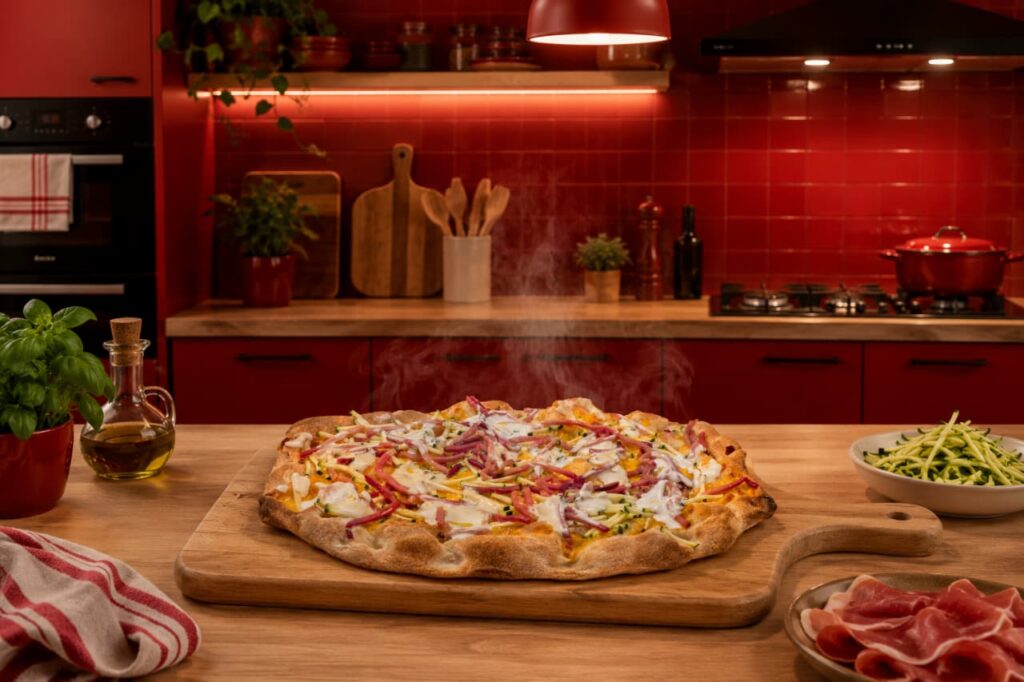
Pinsa is simple to prepare, but that doesn’t mean the result is always guaranteed. Sometimes the base turns out too dry, remains soft in certain areas or even becomes chewy—outcomes that are clearly far from what you were hoping for.
Didn’t your Pinsa turn out the way you wanted? Don’t worry. Preparing Pinsa at home is within everyone’s reach, but sometimes small details, from baking to toppings, can make all the difference to the final result. We’re sorry when it happens, because we’d like you to enjoy it at its very best, exactly as Corrado Di Marco imagined it. The good news is that every imperfect Pinsa has a specific cause behind it, and it’s often much simpler than you might think.
Your Pinsa Turned Out Too Dry
If your Pinsa turned out dry, in most cases the cause lies in the baking temperature, baking time and the way the toppings were handled.
Overbaking the Pinsa: The Number One Cause
Di Marco Pinsa is designed to bake quickly: leaving it in the oven just a few minutes longer than necessary can cause it to lose part of the internal moisture that keeps it soft inside and crispy on the outside.
- It’s not just a matter of time. The instructions on the package assume that the oven has already reached the correct temperature. Placing the Pinsa in the oven while it is still heating up means exposing it to heat for longer than intended, with the risk of drying it out excessively.
- The position of the oven rack can also influence the final result. If the Pinsa is placed too close to the upper heating elements, the surface tends to lose moisture more quickly. A central rack position is preferable because it allows for more even baking.
- Looking through the oven door, many people see a Pinsa that already appears cooked but decide to leave it in for another minute or two to make it crispier. In reality, that extra minute beyond the recommended baking time makes the Pinsa drier, not crispier.
Toppings That Tend to Dry Out the Preparation
If baking time isn’t the issue because you’ve followed the instructions correctly, then the toppings are probably responsible.
- Some ingredients tend to lose a significant amount of moisture during baking. This is the case, for example, with cured meats, certain aged cheeses and cooked vegetables. If your Pinsa is topped almost exclusively with these ingredients, the final result may be drier than expected and should be corrected. To avoid this, simply combine them with ingredients that contain more moisture, such as mozzarella, burrata, tomato or fresh vegetables added after baking.
- Pay attention to how the toppings are distributed as well. If the ingredients are concentrated in just a few areas while much of the base remains uncovered, some bites will be perfectly balanced whereas others will be noticeably—and excessively—dry. Before baking, try to distribute the toppings evenly without overloading the Pinsa.
The solution is not to add more ingredients, but to choose them more carefully and use them in the right order. Fresh cheeses added after baking, light creams, properly prepared vegetables or sauces can all help create a harmonious result without covering the characteristic crispness of the Pinsa.
Your Pinsa Turned Out Chewy: Why?
Pinsa should be neither dry nor excessively soft. Its greatest strength lies precisely in its balance: a crispy exterior, a soft interior, fragrant and pleasantly light to enjoy.
As we’ve seen, when this balance is lost, the Pinsa can become too dry or, on the contrary, excessively soft, to the point of feeling chewy.
There are several possible causes. All of them are easy to correct, although they are not always obvious.
Your Pinsa Absorbed Too Much Moisture
When the Pinsa turns out too soft, the first thing to examine is moisture. A base that is meant to be light and crispy can quickly lose some of its qualities when it comes into contact with ingredients that release a large amount of water.
Fresh mozzarella that hasn’t been drained properly, burrata, stracciatella, cherry tomatoes or freshly cooked vegetables all transfer much of their moisture to the base.
The problem is not using these ingredients—in fact, many of the most popular toppings belong to this category. The real difference lies in how they are handled: draining them properly, patting them dry when necessary or adding them after baking helps preserve the right balance between softness and crispness.
Ingredients taken straight from the refrigerator also deserve attention. The temperature difference can encourage condensation to form, contributing to a softer Pinsa surface. Let them sit at room temperature for a while before placing them on top.
Too Many Toppings on the Base
Pinsa is versatile, but that doesn’t mean it can support large quantities of toppings without consequences.
- An overloaded base tends to retain more moisture and heat. As a result, the surface struggles to maintain its characteristic crispness and may develop a softer texture than intended.
- An excessive amount of toppings also makes it more difficult for the base to bake properly, especially in the center.
For this reason, a well-balanced Pinsa with a few carefully selected ingredients generally delivers a better result than one overloaded with toppings.
What About the Baking?
Of course, there’s also the simplest and most immediate explanation: underbaking. We’ve left it until last simply because it’s the most obvious one.
You may remove the Pinsa from the oven a few minutes too early or place it in the oven before it has reached the correct temperature. In the latter case, following the recommended 5–8 minutes of baking indicated on the package is not enough, because part of that time will be spent waiting for the oven to reach the correct temperature. The result will be a Pinsa that is still undercooked and has a chewy texture.
This is probably the most intuitive explanation, but not necessarily the most common one. Before blaming the chewy texture entirely on the baking process, it’s worth checking how the ingredients were handled, as they can have a greater impact on the final result than many people realize.
Enjoy Pinsa the Way Corrado Di Marco Intended
Our ambition is for you to enjoy Pinsa exactly as we imagined it back in 2001: crispy on the outside, soft on the inside, light and capable of enhancing every single ingredient.
These qualities are what have allowed Pinsa to win over millions of people around the world, and why we continue to produce it according to Corrado Di Marco’s original recipe, with the same attention to quality, craftsmanship and ease of preparation.
A few small details during baking and topping can make all the difference. Once everything finds the right balance, however, the result speaks for itself. Try it and see for yourself.